
Net Metering in Andhra Pradesh (2026): APSPDCL, APEPDCL and APCPDCL Process and Timeline
Andhra Pradesh changed its rooftop solar rules in 2025 and 2026. Here is what now applies with APSPDCL, APEPDCL and APCPDCL, from limits and fees to the net meter process.
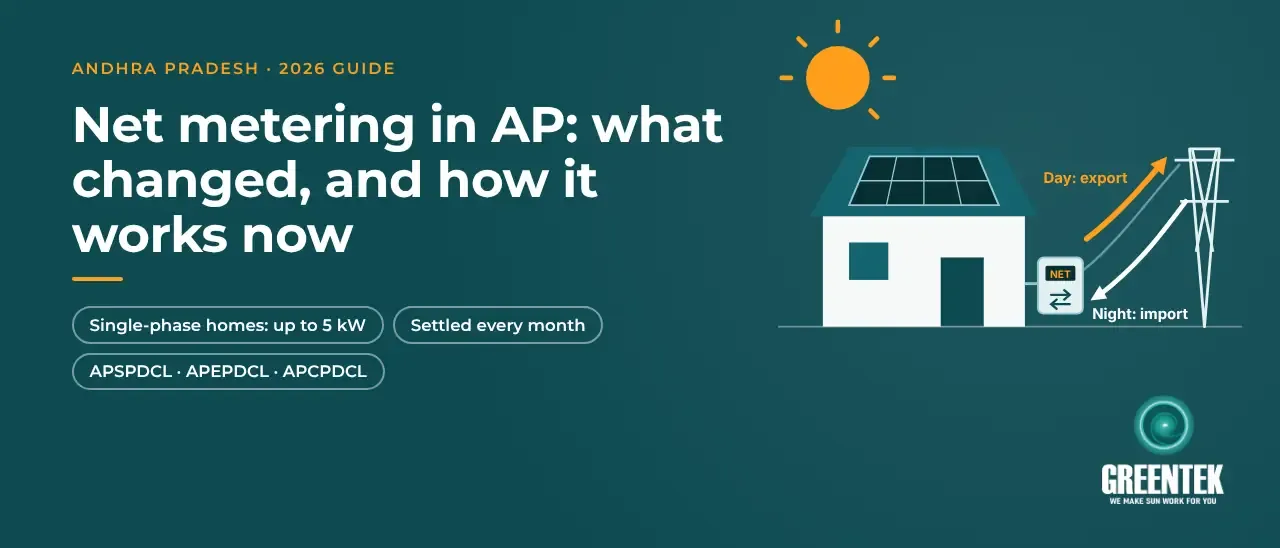
Quick answer: In Andhra Pradesh, rooftop solar net metering is governed by APERC Regulation No. 4 of 2023, as amended by Regulation No. 10 of 2025. Homes apply through the PM Surya Ghar national portal (or the DISCOM website or Mee Seva), and the DISCOM checks feasibility, inspects the system and fits a bi-directional meter. Exports are adjusted against your consumption every billing month. Since August 2026, single-phase homes can install up to 5 kW (earlier 3 kW), and domestic PM Surya Ghar systems up to 10 kW do not pay application fees or net metering charges.
Andhra Pradesh has changed its rooftop solar rules more than once in the last eighteen months. A homeowner in Visakhapatnam, Vijayawada or Tirupati who read a guide in 2024 may be working from outdated limits. This post sets out what applies now, which DISCOM you deal with, and how the process actually runs.
Which DISCOM handles your net meter?
Your net metering application goes to the distribution company that already bills you. The consumer number on your electricity bill decides it.
| DISCOM | Headquarters | Broad service area |
| APEPDCL (Eastern) | Visakhapatnam | North coastal Andhra and the Godavari districts |
| APCPDCL (Central) | Vijayawada | Krishna, Guntur and Prakasam regions |
| APSPDCL (Southern) | Tirupati | Rayalaseema and Nellore regions |
All three follow the same APERC regulation, so the rules below apply statewide. What differs is section office workload, which is the biggest reason two neighbours in different districts see different timelines.
The rules that apply in 2026

APERC's Grid Interactive Solar Rooftop Photovoltaic Systems under Net/Gross Metering Regulation, 2023 is the base. Its First Amendment, Regulation No. 10 of 2025 (order dated 4 December 2025, with an errata on 8 January 2026), rewrote several limits. The points a household needs:
| Rule | What it says | Source |
| Net metering capacity | 1 kW to 500 kW per consumer, capped at your contracted load | Reg. 10 of 2025, clause 5.6 |
| Single-phase homes | Up to 5 kW, matching sanctioned load (earlier 3 kW) | APERC order, 5 August 2026 |
| Application fee (general) | Nil up to 5 kWp; Rs 1,000 above 5 kWp to 100 kWp | Reg. 10 of 2025, clause 11.2 |
| Domestic PM Surya Ghar systems | Application fee and net metering charges waived up to 10 kW | APERC order, April 2025 |
| Settlement | Exports adjusted against imports every billing month | Reg. 4 of 2023, clause 16, as amended |
| Agreement deadline | Signed agreement due within four months of technical feasibility, or the application lapses | Reg. 10 of 2025, clause 13.1 |
The single-phase change matters most for homes
Many Andhra homes run on single-phase connections with a sanctioned load of up to 5 kW, but the 2023 regulation capped single-phase rooftop systems at 3 kW. Applications above 3 kW were being rejected, including under PM Surya Ghar. After a representation from APEPDCL, APERC used its removal of difficulty power on 5 August 2026 to allow single-phase systems up to 5 kW, and directed all three DISCOMs to apply it uniformly. If your earlier application was turned down for this reason, it is worth reapplying.
Monthly settlement and surplus payments
Under the regulation, units you export are set off against units you import in each billing month. Surplus exports are paid at the feed-in tariff fixed by APERC. In early 2026, after complaints at tariff hearings that some DISCOMs were not following the monthly process, APERC directed them to settle monthly and to credit surplus payments electronically to the consumer's bank account without delay. Keep your bank details up to date with your DISCOM.
The process, step by step
1. Register and apply
For homes, the usual route is pmsuryaghar.gov.in: select Andhra Pradesh and your DISCOM, enter your consumer number, and submit the rooftop application. APERC also accepts applications through DISCOM websites and Mee Seva centres. The name on the application must match the name on the electricity bill exactly.
2. Technical feasibility
The DISCOM checks your connection, sanctioned load and local network before approving the capacity. The four-month clock for signing the agreement starts here.
3. Installation by a registered vendor
You choose a DISCOM-registered vendor, and the system is installed. The inverter is the part that talks to the grid, so it must meet the technical standards the DISCOM inspects against.
4. Inspection, agreement and net meter
After installation, the plant details are uploaded and the net meter is requested. The DISCOM inspects earthing, protections and inverter settings, executes the agreement and fits the bi-directional meter.
5. Commissioning and subsidy
Once approved, the portal issues the commissioning certificate. You upload bank details and a cancelled cheque, and the central subsidy (Rs 30,000 for 1 kW, Rs 60,000 for 2 kW, and a maximum of Rs 78,000 for 3 kW and above) is released to your account.
New options for apartments and multiple connections
The 2025 amendment added two arrangements that did not exist before in Andhra Pradesh:
- Virtual net metering (5 kW to 500 kW): a housing society or group installs one system and the exported energy is shared among members' connections by an agreed ratio.
- Group net metering (1 kW to 500 kW): one owner's generation offsets consumption across several of their own connections within the same DISCOM area.
Both are useful for gated communities and families with more than one service connection. The sharing ratio can be changed once per financial year with one month's notice.
Frequently asked questions
Do I apply separately to the DISCOM if I use PM Surya Ghar?
No. Applying on the national portal with your DISCOM consumer number starts both the subsidy track and the DISCOM net metering track.
Is there any fee for a 3 kW home system?
Under the April 2025 APERC order, domestic PM Surya Ghar systems up to 10 kW are exempt from application fees and net metering charges. Your vendor should confirm any remaining costs in writing before installation.
What happens to extra units I export?
They are first set off against your consumption in the same billing month. Net surplus is paid at the APERC feed-in tariff and credited to your bank account.
Can a zero-export system skip net metering?
Yes, behind-the-meter systems that never export are allowed, but the DISCOM must be informed in advance and the system must prevent export. For most homes, net metering gives better value.
Does my solar work during a power cut?
A standard on-grid system shuts down during an outage for lineman safety. If backup matters, ask about a hybrid inverter with battery.
APERC regulations, DISCOM procedures and scheme parameters can be revised. This guide is current as of October 2026.
Planning rooftop solar in Andhra Pradesh?
Greentek's Secunderabad team has worked in solar since 1997. We can look at your bills and roof, size a system that fits the current limits, and explain each DISCOM step before you commit.
About the Author
About Greentek
Get a Free Solar Quote
A Greentek engineer will call you within 24 hours.
Need Solar Solutions?
Interested in learning more about our solar energy solutions? Get in touch with our experts.
Get Free Consultation