
Solar Thermal vs Solar Photovoltaic for Industrial Process Heating: Efficiency and Investment Perspective
Industrial heating is energy-intensive—choosing the right solar technology can change that. Solar thermal and PV offer different paths, but their efficiency and investment impact vary significantly.
Understanding the Difference
✅ Solar Thermal Systems
- Directly convert sunlight into heat
- Used for:
- Hot water generation
- Steam generation
- Process heating (textiles, food, chemicals, etc.)
✅ Solar Photovoltaic (PV) Systems
- Convert sunlight into electricity
- Electricity is then used to:
- Run heaters
- Power boilers
- Support overall plant operations
👉 In simple terms:
Solar Thermal = Direct heat generation
Solar PV = Electricity → then heat (indirect)
Efficiency Comparison
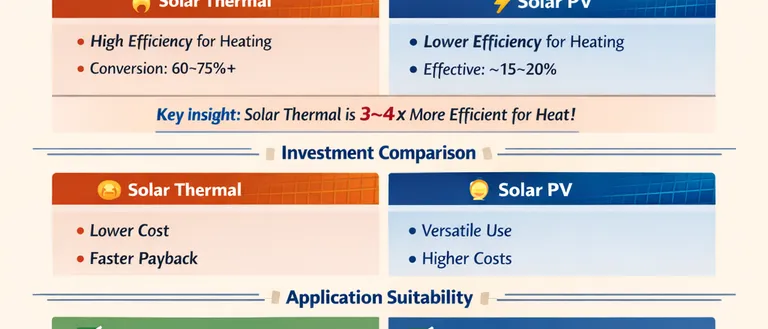
🔥 Solar Thermal: High Efficiency for Heating
- Conversion efficiency: 60–75%+
- Converts solar energy directly into usable heat
- Minimal conversion losses
✅ Ideal for:
- Continuous thermal demand
- Medium temperature applications (60°C to 250°C+)
⚡ Solar PV: Lower Effective Efficiency for Heating
- Electricity conversion efficiency: 15–22%
- Further efficiency loss when converting electricity into heat
👉 Effective thermal efficiency: ~15–20%
🎯 Key Insight
For process heating:
Solar thermal is 3–4 times more efficient than PV when the end-use is heat.
Investment Comparison
💰 Solar Thermal Investment
Advantages:
- Lower cost per unit of useful heat
- Faster payback (often 2–4 years)
- Minimal operational cost
- Long system life (15–20+ years)
Limitations:
- Application-specific (only heat)
- Requires integration with existing boiler systems
💡 Solar PV Investment
Advantages:
- Versatile (can power entire facility)
- Easier to deploy (plug-and-play in many cases)
- Strong policy support (net metering, open access)
Limitations:
- Higher cost for heating applications
- Inefficient route for thermal loads
- Requires electric boilers or heating systems
🎯 Cost Perspective
| ParameterSolar ThermalSolar PV (for heating) | ||
| Conversion efficiency | High (60–75%) | Low (~15–20%) |
| Cost per useful kWh (heat) | Low | High |
| Payback period | Faster | Longer |
| Best use case | Process heating | Power + general load |
Application Suitability
✅ Solar Thermal is Best For
- Textile processing
- Food & beverage industries
- Dairy and pharma
- Chemical processes
- Hotels and hospitals
👉 Especially where thermal demand is continuous
✅ Solar PV is Best For
- Electrical loads
- Lighting, motors, equipment
- Partial heating support
- Hybrid systems
👉 Works well when multi-purpose energy use is required
Operational Perspective
🔧 Solar Thermal
- Simple system (collectors, storage, piping)
- Low maintenance
- Highly reliable for repetitive heating loads
🔌 Solar PV
- Requires additional systems for thermal use
- Higher dependency on electrical infrastructure
Strategic Insight for Industry Leaders
Many industries make a common mistake:
👉 Using solar PV for applications where solar thermal is more appropriate
This leads to:
- Higher costs
- Lower efficiency
- Suboptimal ROI
✅ Best Approach
Rather than choosing one over the other:
👉 Use a hybrid strategy
- Solar thermal for process heating
- Solar PV for electrical loads
- Storage or backup integration
Future Outlook
The future of industrial energy lies in:
- Integrated solar solutions
- Hybrid energy systems (thermal + PV + storage)
- AI-driven energy optimization
- Decentralized energy production
Industries that understand application-specific technology selection will gain the maximum advantage.
Final Thought
Solar energy is not one-size-fits-all.
The real value lies not in adopting solar —
but in choosing the right solar technology for the right application.
For industrial process heating, the answer is clear:
👉 Solar Thermal is not just an alternative — it is often the most efficient and cost-effective solution.
Related
Greentek manufactures its own flat plate collectors, absorber fins and storage tanks at its factory in Medak, Telangana, and delivers industrial process heat and boiler pre-feed systems from 2,000 to 1,00,000 LPD. See solar water heating systems for the full range, the zero-capex model and delivered institutional projects.
About the Author
About Greentek
Get a Free Solar Quote
A Greentek engineer will call you within 24 hours.
Need Solar Solutions?
Interested in learning more about our solar energy solutions? Get in touch with our experts.
Get Free Consultation