
Solar Thermal Technologies Explained: FPC, ETC, Heat Pipe & Reflector Systems for Industrial Applications
Solar thermal technologies offer the most efficient way to generate heat from sunlight. From FPC to ETC and reflector systems, each technology serves distinct industrial heating needs.
Why Solar Thermal is Critical for Industry
While solar PV dominates discussions, a large portion of industrial energy demand is actually thermal—used in:
- Process heating
- Steam generation
- Hot water applications
Solar thermal systems directly convert sunlight into heat, making them significantly more efficient for these applications compared to electricity-based solutions.
Types of Solar Thermal Collector Technologies
Solar thermal systems are broadly classified into:
👉 Non-concentrating collectors (FPC, ETC)
👉 Concentrating collectors (reflector-based systems)
Each has a specific role depending on temperature requirement and scale.
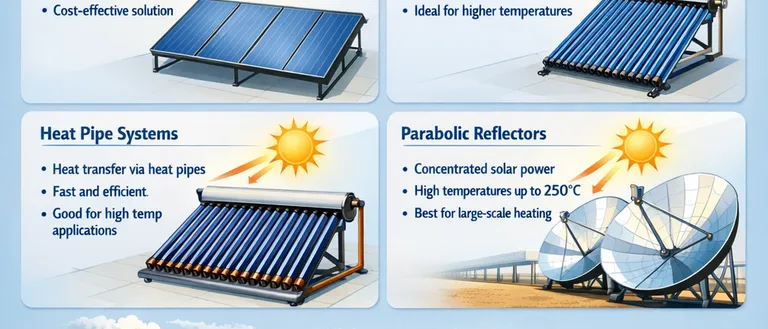
1. Flat Plate Collector (FPC)
✅ Working Principle
A flat plate collector consists of:
- A black-coated absorber plate (copper/aluminum)
- Transparent glass cover
- Insulated casing
- Fluid-carrying pipes
Sunlight passes through the glass, heats the absorber, and transfers heat to water or fluid.
✅ Performance
- Typical temperature range: up to ~100°C
- Moderate thermal efficiency (~70–80% in ideal conditions)
✅ Advantages
- Simple and robust design
- Lower capital cost
- Suitable for high solar radiation regions
❌ Limitations
- Heat losses due to convection
- Lower efficiency in cold weather
- Limited for higher temperature applications
✅ Best Applications
- Domestic hot water
- Low-temperature industrial heating
- Hotels, hospitals
2. Evacuated Tube Collector (ETC)
✅ Working Principle
ETC systems use glass tubes with vacuum insulation between layers.
- Inner absorber tube captures solar heat
- Vacuum prevents heat loss
- Heat transferred to fluid via direct flow or heat pipe
The vacuum dramatically reduces thermal losses.
✅ Performance
- Temperature range: 60°C to 200°C+
- Higher efficiency than FPC, especially in colder conditions
- Thermal efficiency: ~80–90%
✅ Advantages
- Superior heat retention
- Works even in cloudy or cold climates
- Higher output temperatures
❌ Limitations
- Higher initial cost (20–40% more than FPC)
- Fragile glass tubes
✅ Best Applications
- Industrial hot water
- Medium-temperature process heating
- Dairy, food, textile sectors
3. Heat Pipe Evacuated Tube Collectors
✅ Working Principle
A variation of ETC, these systems use a heat pipe mechanism:
- A sealed copper pipe contains a working fluid
- Fluid evaporates at low temperature
- Vapor rises, transfers heat in the manifold, and condenses
- Cycle repeats continuously
Heat pipes enable rapid heat transfer with minimal losses.
✅ Performance Advantage
- Faster heat transfer compared to direct flow systems
- Consistent performance across varying conditions
- Improved reliability and scalability
✅ Key Benefit
👉 More efficient heat transfer with lower temperature losses
✅ Use Cases
- Industrial process heating
- Systems requiring rapid temperature rise
- Hybrid thermal systems
4. Reflector-Based Solar Thermal Systems
These are concentrating solar thermal technologies.
✅ Types:
- Compound Parabolic Collectors (CPC)
- Parabolic Trough Systems
- Linear Fresnel Reflectors
✅ Working Principle
- Reflectors concentrate sunlight onto a receiver
- Heat is concentrated → higher temperatures achieved
✅ Performance
- Temperature range:
- CPC: up to ~240°C
- Parabolic systems: 300°C+
✅ Advantages
- High-temperature capability
- Suitable for industrial steam and power
- Efficient at scale
❌ Limitations
- Higher capital investment
- Requires tracking systems
- More complex operation
✅ Best Applications
- Industrial steam generation
- Large process heat requirements
- Utility-scale solar thermal plants
Technology Comparison Summary
| ParameterFPCETCHeat Pipe ETCReflector Systems | ||||
| Temperature range | Low (~100°C) | Medium (200°C) | Medium-high | High (300°C+) |
| Efficiency | Moderate | High | Higher | Very high (at scale) |
| Cost | Low | Medium | Medium-high | High |
| Complexity | Simple | Moderate | Moderate | High |
| Best use | Domestic/low heat | Industrial hot water | Process heating | Steam/large industrial |
Strategic Insight for Industry
One of the biggest gaps I see in industry adoption is:
👉 Treating all solar technologies as the same.
In reality:
- FPC works for basic heating
- ETC works for efficient industrial heating
- Heat pipe systems improve performance and reliability
- Reflectors unlock high-temperature applications
✅ The Right Approach
Instead of choosing a single solution:
👉 Design based on temperature requirement
- <100°C → FPC
- 100–200°C → ETC / Heat pipe
200°C → Reflector systems
Final Thought
Solar thermal is not just about adopting renewable energy.
It is about:
👉 Matching the right technology to the right application
Because the real efficiency in solar does not come from the sun.
It comes from engineering choices.
Related
Greentek builds these collectors itself — copper absorber fins, nine risers, 96% absorptivity, BIS licensed to IS 12933 — at its factory in Medak, Telangana. See how we manufacture collectors, or solar water heating systems for the complete range, capacities and delivered institutional projects.
About the Author
About Greentek
Get a Free Solar Quote
A Greentek engineer will call you within 24 hours.
Need Solar Solutions?
Interested in learning more about our solar energy solutions? Get in touch with our experts.
Get Free Consultation