
Centralised Solar Monitoring for EPCs: Cost Savings, Scalability & Profitability
Managing thousands of rooftop systems manually is inefficient. Centralized solar monitoring is becoming essential for EPCs to reduce costs, improve performance, and scale profitably.
A Realisation from the Field
Over the last few years, I’ve been closely involved in scaling rooftop solar businesses.
And one thing became very clear, very quickly:
👉 Installing solar systems is not the difficult part anymore.
👉 Managing them efficiently at scale is.
When you move from 20 installations to 2,000 installations across different locations, the game changes completely.
What used to be manageable manually becomes chaotic without the right systems in place.
That’s where centralised performance monitoring comes in—not as a luxury, but as a necessity.
The Problem Most EPCs Don’t See Early
In the residential segment, every system is small.
But collectively?
👉 They form a massive distributed asset network.
And the problems start showing up as scale increases:
- No visibility into actual performance
- Customers complaining about low generation
- Field teams constantly on the move
- Rising O&M costs eating into margins
Most EPCs underestimate this phase.
By the time they realise it, margins are already under pressure.
What Centralised Monitoring Changes
At its core, a centralised monitoring system gives you one simple advantage:
👉 Visibility.
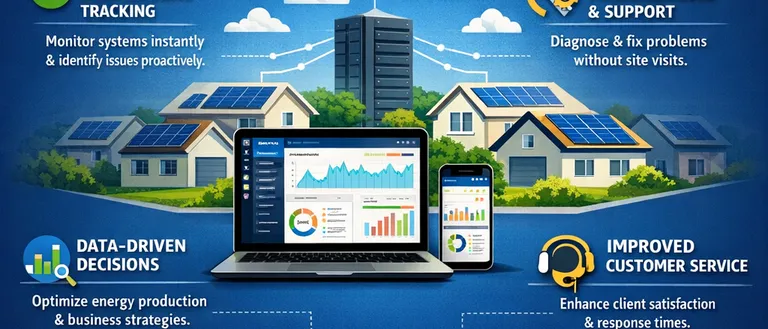
Instead of managing hundreds of systems blindly, you can:
- Track real-time generation
- Monitor inverter performance
- Identify faults instantly
- Compare performance across sites
It becomes your control room for distributed solar assets.
Where the Real Cost Savings Come From
Let’s talk about the part that really matters for EPCs:
👉 Cost reduction and margin improvement
1. O&M Cost Reduction
Traditionally, maintenance is reactive.
A customer calls → team visits → issue is diagnosed on site.
With monitoring:
- Faults are detected instantly
- Issues are diagnosed remotely
- Only necessary visits are made
This shift from reactive to predictive maintenance leads to:
👉 Significant reduction in annual O&M costs
👉 Lower dependency on field service teams
👉 Fewer unnecessary site visits
2. Reduction in Manpower Dependency
Without monitoring, scaling means:
👉 More projects = more technicians
With centralised monitoring:
👉 More projects ≠ proportional increase in manpower
One team can monitor multiple installations remotely, and field teams are deployed only when required.
This is where real operational leverage is created.
3. Preventing Invisible Revenue Loss
One of the biggest hidden problems in residential solar:
👉 Systems underperforming without anyone noticing
Small issues like:
- Faulty strings
- Inverter inefficiencies
- Dust or shading
can reduce output silently.
Without monitoring, these losses go unnoticed for months.
With monitoring:
👉 Even small deviations are detected early
👉 Corrective action is faster
👉 Performance remains optimal
For the customer, it means better ROI.
For the EPC, it means credibility and fewer escalations.
4. Downtime Reduction = More Value Delivered
Every hour of downtime is lost generation.
Centralised systems enable:
- Instant alerts
- Faster troubleshooting
- Reduced downtime
High-performing EPCs today are achieving near 99% uptime by leveraging monitoring systems.
That’s not just a technical metric—it’s a business advantage.
5. Scaling Without Losing Control
This is the biggest shift.
Without monitoring: 👉 Every additional project adds operational burden
With monitoring: 👉 Scale becomes manageable
You move from:
- Managing systems individually
to:
- Managing a portfolio of assets
And that changes the entire business model.
6. Creating Recurring Revenue Streams
Most EPC companies focus only on installation revenue.
But the real long-term opportunity lies in:
👉 O&M and performance management
Centralised monitoring enables:
- Annual maintenance contracts
- Performance guarantee services
- Subscription-based monitoring models
This transforms EPC from: 👉 One-time business
to: 👉 Recurring revenue business
The Bigger Shift: EPC to Asset Manager
This is where the industry is heading.
The future EPC is not just someone who installs systems.
It is someone who:
👉 Owns performance
👉 Manages assets
👉 Delivers long-term value
And centralised monitoring is at the core of this transition.
What Happens If You Ignore This
Let me be very direct here.
EPCs that don’t adopt monitoring early will face:
- Increasing service costs
- Lower customer satisfaction
- Limited scalability
- Shrinking margins
Because as installations grow, inefficiencies multiply.
Final Thought
In residential solar, the biggest cost is not installation.
It’s what happens after installation.
Centralised monitoring is not just a tool.
👉 It is the foundation of building a scalable, profitable, and future-ready solar business.
About the Author
About Greentek
Get a Free Solar Quote
A Greentek engineer will call you within 24 hours.
Need Solar Solutions?
Interested in learning more about our solar energy solutions? Get in touch with our experts.
Get Free Consultation